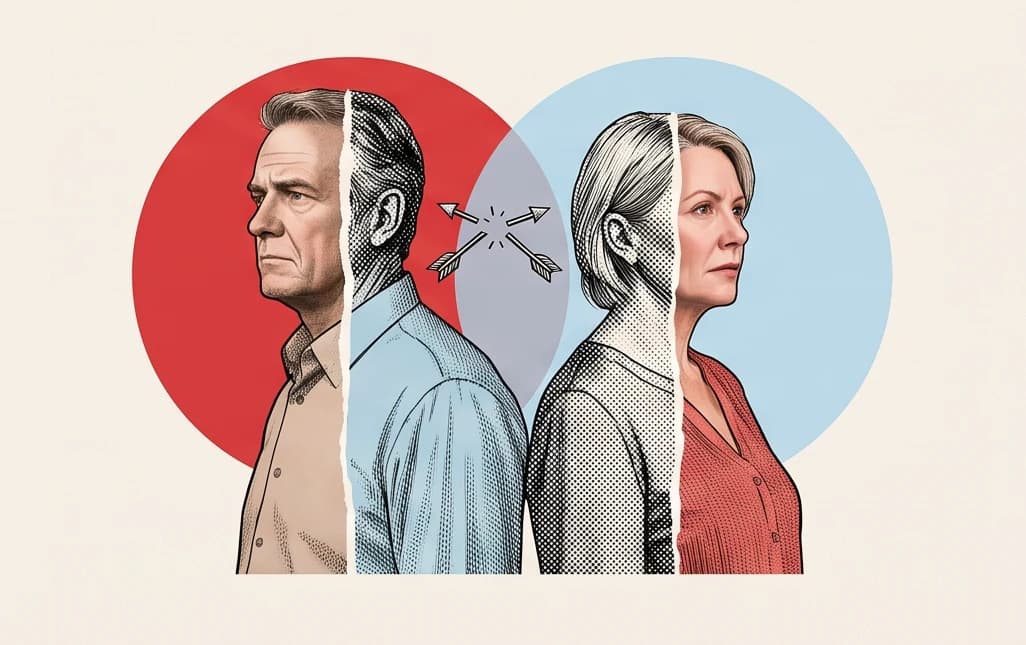
To reduce executive team conflict, first separate the two kinds. Keep task conflict, the open disagreement about strategy and decisions. Stop relationship conflict, the personal and resentful kind, as early as you can. Then build trust, name who owns each decision, and end every debate with a commitment everyone can repeat.
Is all executive team conflict bad?
No. Disagreement about the work makes decisions better. Disagreement about the people makes everything worse.
Task conflict is about which market to enter, which hire to make, whether the roadmap is right. Relationship conflict is mistrust, contempt and the feeling that a colleague is the obstacle. A long-running meta-analysis found relationship conflict reliably harms performance and satisfaction, while task conflict does far less damage and can help (De Dreu and Weingart).
| Task conflict: keep it | Relationship conflict: stop it | |
|---|---|---|
| About | Ideas, strategy, trade-offs | People, history, status |
| Feels like | Sharp questions, real debate | Defensiveness, contempt |
| Effect | Fewer blind spots | Less trust, less shared information |
| Your job | Make it safe | Interrupt it early |
Strong teams argue about ideas and stay warm with each other. Weak teams do the opposite: polite in the room, resentful outside it.
Why does executive conflict turn personal?
Low trust, and a team that believes it is losing. Left alone, an argument about a decision turns into a grudge about the person who made it.
One study found task conflict grows into relationship conflict mainly when a team already thinks it is underperforming (Guenter et al.). When the team feels it is doing well, disagreement stays about the work. With high trust, a challenge improves the idea. With low trust, the same challenge sounds like an attack.
How do you reduce the tension?
Five habits, in this order, because each one makes the next possible.
- Build trust first. Teams cannot debate honestly until they trust each other enough to disagree safely (Mindtools on Lencioni).
- Say the hard thing in the room. If someone is holding back, say so. The disagreement you avoid moves to the corridor.
- Name who owns each decision. Much friction is about who gets to decide, not the answer. Overlapping authority creates conflict. Write the owners down before the debate (HBR).
- Keep it on the decision. When a debate starts to sound like a judgment of character, stop and restate it as a choice between options.
- End with a commitment. Make a clear call and get visible buy-in, even from people who disagreed.
How do you keep tension from building up?
Talk about it every week, in small doses, before it hardens. Waiting for a blow-up and then calling in help costs far more.
Add a standing item to your leadership meeting about how the team is working, separate from what it is shipping. Check where trust is thin and where authority is unclear, and revisit decision owners whenever the team or the strategy changes.
For a shared picture of where the gaps are, see leadership team alignment and how to measure team dynamics. When the conflict is between founders, where the history runs deepest, our guide to cofounder conflict resolution goes further into repairing the relationship itself.
Frequently asked questions
- Is all conflict on an executive team bad?
- No. Task conflict, meaning disagreement about ideas, strategy and priorities, sharpens decisions and guards against groupthink. Relationship conflict, meaning personal friction and resentment, is the kind that damages performance. The aim is plenty of the first kind and almost none of the second, not a leadership team that never disagrees.
- What is the difference between task conflict and relationship conflict?
- Task conflict is about the work: which market, which hire, which trade-off. Relationship conflict is about the people: mistrust, contempt and old history. Task conflict can improve results when trust is high. Relationship conflict reliably harms how well a team shares information, works together and performs over time.
- How do you stop task conflict from turning personal?
- Build trust first, keep the debate on the decision instead of the person, make clear who owns each call, and end every disagreement with a clear commitment. Research suggests task conflict turns personal mostly when trust is low, or when the team already feels it is failing and starts looking for someone to blame.
- Why does my leadership team avoid conflict entirely?
- Usually because of trust, not temperament. When people do not feel safe disagreeing, they go quiet in the meeting and lobby afterwards. That polite surface is more dangerous than open debate, because the real disagreement never gets settled and comes back later as slow, half-hearted execution of the decision.
- How often should an executive team address tension directly?
- Often, in small doses. Name friction while it is small and cheap to fix, instead of waiting for a blow-up. A short standing item in the leadership meeting, about how the team is working together and not only what it is shipping, stops tension from building up over weeks.