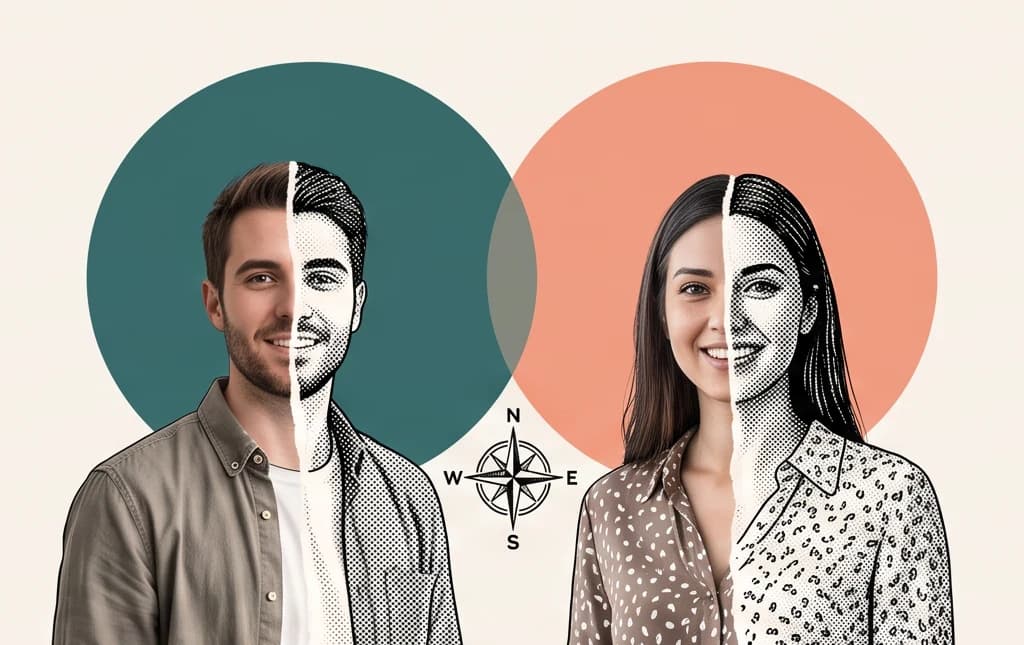
In the choice of team alignment vs personality assessment, the two do different jobs. A personality assessment describes each person's traits. Team alignment settles how the group decides, who owns what and where it is heading. The first builds self-awareness. The second changes behaviour, which is where results come from. Use them in that order.
Most teams stop after the first. They run a test, share the results in a workshop, recognise themselves for an afternoon, and go back to working exactly as before.
What does a personality assessment measure?
Individual tendencies: how you take in information, how you recharge, how you weigh a decision. Done well, it gives a team shared words for its differences. "I think out loud and you think in silence" makes a whole kind of friction easier to discuss.
Not every test is done well. Psychology Today notes that type-based tests with forced choices can move a person into the opposite category after a couple of changed answers, while continuous, validated models like the Big Five hold up far better. Some popular online tests use descriptions vague enough to fit anyone.
What does team alignment measure?
Agreement on the things that decide outcomes. Who owns what. What done means. How you make a call when you disagree. What happens when someone is overloaded.
A personality test can tell you your co-founder is detail-focused. It cannot tell you that the two of you have no rule for when a decision is final. Knowing the trait does not end the standoff. Agreeing the rule does.
| Personality assessment | Team alignment | |
|---|---|---|
| Measures | Individual traits and preferences | Shared expectations, decisions, direction |
| Changes | Self-awareness | How the group coordinates |
| Time frame | A snapshot, mostly stable | Revisited as the team changes |
| Best use | Onboarding, shared vocabulary | Turning awareness into agreements |
| Fails when | Treated as a fixed label | Run once and never revisited |
Which one actually drives results?
Alignment, with personality insight as the prompt. Predictive Index reports that teams using personality tools thoughtfully saw a 15 percent gain in engagement and a 25 percent cut in turnover. A separate case study recorded a 35 percent drop in turnover once assessments were built properly into hiring.
Look at where those gains came from: the discussion afterwards, the changes to roles, the agreement to work differently. Predictive Index itself calls the insight a starting point for discussion, not a fixed label.
Personality tests go wrong in two ways. The result becomes an identity ("I'm an introvert, so I don't run meetings") and starts excusing behaviour instead of explaining it. Or the test is the whole intervention: a workshop, a poster of everyone's type, and six months later the friction is where it was.
How do you use both?
In sequence.
- Run a personality assessment your team trusts, or skip it if you have none.
- Use the results to build shared language and some patience for how people differ.
- Turn that into agreements: who decides, what good looks like, how you raise friction early.
- Write the agreements down and revisit them as the team changes.
For the wider picture across a leadership team, read our guide to leadership team alignment. If you are comparing tools, see alternatives to CliftonStrengths and DISC. To check whether alignment is improving, start with how to measure team dynamics, then look at the Teams Align product.
Frequently asked questions
- Are personality assessments worth using at work?
- Yes, as a starting point. A well-validated personality assessment builds self-awareness and gives a team shared words for how people differ. On its own it does not change how the group makes decisions or splits work. Treat the result as the start of a conversation, never as a final verdict on a person.
- What is the difference between a personality assessment and team alignment?
- A personality assessment measures one person's traits and preferences. Team alignment checks whether a group agrees on direction, roles, decisions and how it handles friction. The first describes the people on the team. The second changes how those people work together, which is where results come from.
- Do personality tests improve team performance?
- They can, when teams use the results to start discussions and pair them with other information. Companies that apply them this way report better engagement and lower turnover. The gains come from what the team agrees to do differently after reading the results, not from the labels themselves.
- Why do personality test results sometimes feel unreliable?
- Type-based tests that force a choice between two answers can move a person into the opposite category after a change to just a couple of answers. Some online tests also use descriptions vague enough to fit almost anyone. Continuous, validated models such as the Big Five hold up much better.